Reduced (13–24)
Ages 13 to 24 — student or photo ID required at the gate
€17
- Skip-the-line entry to the convent
- Photo ID showing an age of 13 to 24 is checked at the gate for this rate
Convento de Cristo Tickets is an independent concierge service. We facilitate skip-the-line ticket purchases from the official operator on your behalf.
Tomar · Portugal
The Templars' hilltop above Tomar, then the house of the Order that put its cross on the sails of the caravels.
Dated entry · half-day window
Every panel is the same full visit: the Charola, the Manueline nave and Chapter House window, all eight cloisters, the castle keep and the walls. Choose the rate for each visitor; you pick the date and the half-day window at the next step.
Ages 13 to 24 — student or photo ID required at the gate
€17
Ages 25+ — or any age without student/senior ID
€25
Ages 65+ — photo ID required at the gate
€17
At checkout you choose a morning window (09:00 to 14:00) or an afternoon window (14:00 to 18:30, to 17:00 from November to March) and arrive at any point inside it. Your QR ticket goes through the priority lane at the gate.
Two visitors, in their own words
Reviews come from our own customers after the visit and are published in the language they wrote them in.
Exceptional experience
Una maravilla. Deseando que terminen las obras de restauración para poder disfrutarlo en todo su esplendor. Volveremos
At the desk
The practical notes, including the ones that change the day.
Open daily including Mondays. Typically 09:00 to 17:30 from October to May and 09:00 to 18:30 from June to September, last admission 30 minutes before closing. Closed 1 January, 1 March, Easter Sunday, 1 May and 24 to 25 December.
Morning 09:00 to 14:00, or afternoon 14:00 to 18:30 (to 17:00 from November to March). Arrive at any point inside the window you booked.
Igreja do Castelo Templário, 2300 Tomar, Portugal
Tomar is roughly 140 km north-east of Lisbon, just off the A23 motorway. By train: CP runs direct services from Lisbon (Santa Apolónia and Oriente stations) on the Linha do Norte / Linha da Beira Baixa to Tomar in roughly 2 hours; the convent is a 20-minute uphill walk from Tomar station, or a short taxi ride. By bus: Rede Expressos coaches from Lisbon Sete Rios. By car: A1 north then A23 east, signposted from the motorway exit.
Tuesday–Friday early morning (first hour of opening) is the calmest window. Mid-morning brings coach-tour groups. Open daily. The full visit — Charola, Manueline nave, Chapter House window, all eight cloisters, castle keep and outer walls — takes 90 minutes to two hours at a steady pace. Allow longer if you want to walk the wooded grounds around the castle.
Comfortable shoes (steep flagstones, uneven cobbles, climb from the town). The convent buildings are mostly indoor / covered; the cloisters and castle walls are partly open. The interior of the Charola runs cool year-round; the outer terraces are exposed to summer sun and winter wind. Bring water — the cafés are at the town below, not at the gate.
The Charola, the Manueline nave and the ground floor of several cloisters are reachable by adapted routing. The castle keep, the upper galleries, and the older cloisters have step access only. The walk up from the town is steep — drive, taxi, or use the on-site car park if mobility is a concern. Email us before your visit and we'll send the operator's accessibility notes.
Your ticket also opens the Mata dos Sete Montes, the walled woodland inside the outer ramparts, with the seventeenth-century Aqueduto dos Pegões. The easiest way to stretch a half day into a full one.
Restoration works are under way in parts of the complex; visitors in August 2026 mentioned scaffolding. Check the operator's current notices for the areas affected on your date.
The Charola
The two things people travel furthest to see, read as drawings: pins on the plan of the round Templar church and on the face of the Chapter House window.
The Charola is the original heart of the convent and the building visitors come from the furthest to see. It is a round Templar church begun in the 1180s by the order's Portuguese grand master Gualdim Pais — a 16-sided polygon enclosing an octagonal central altar drum, with a high vaulted dome above. The design echoes the Church of the Holy Sepulchre in Jerusalem and the Dome of the Rock — both buildings the Templars knew first-hand during their century-long presence in the crusader Kingdom of Jerusalem. Round Templar churches are rare in Europe; only a handful survive, mostly in England (the Temple Church in London, Cambridge's Round Church).
The cloisters
Each generation of patrons added its own courtyard. Walking them in sequence is a walking history of Portuguese architecture from about 1400 to 1620.
15th century
Built around 1433 under Prince Henry the Navigator when he was grand master of the Order of Christ; the burial cloister of the knights.
15th century
Its twin from the same campaign under Henry the Navigator, where the community washed; the two together are the oldest cloisters on the hill.
16th century
The Claustro da Hospedaria housed pilgrims and visiting dignitaries.
1557 to 1591
The masterpiece: two storeys of classical arcades with serlianas on the upper level, begun by Diogo de Torralva and completed by Filippo Terzi — a deliberate break from the Manueline exuberance of the generation before and one of the finest Renaissance courtyards in Iberia.
Late 16th to early 17th century
The Claustro dos Corvos, from the campaigns that followed the great cloister.
Late 16th to early 17th century
One of the later courtyards added as the community grew.
Late 16th to early 17th century
Added under Philip II of Spain during the Iberian Union, when the convent was extended once more.
15th to 17th century
The chapter houses, refectories and dormitories that adjoin the cloisters were the working spaces of the Order; most upper-storey rooms now hold interpretive panels and small exhibitions.
Walking the eight cloisters in sequence is a walking history of Portuguese architecture from 1400 to 1620. The visitor circuit normally takes them in a logical loop; allow 45 to 60 minutes to walk through all of them with attention. The chapter houses, refectories and dormitories that adjoin the cloisters were the working spaces of the Order of Christ community. Most of the upper-storey rooms now hold interpretive panels and small exhibitions.
Two orders
The one genuinely confusing thing about Tomar, set out as a charter opened flat: the order that was dissolved on the left, the order that inherited everything on the right.
Convento de Cristo sits on a wooded hilltop above the small town of Tomar in central Portugal. The site was granted to the Knights Templar in 1159 by the first king of Portugal, Afonso Henriques, in recognition of the order's military support during the reconquista. The Templar grand master Gualdim Pais founded the castle in 1160 and began construction of the round Charola — the order's church — in the 1180s. The Charola was modelled on the Church of the Holy Sepulchre in Jerusalem and the Dome of the Rock, both of which the Templars knew first-hand from their century-long presence in the crusader Holy Land.
Convento de Cristo — the Convent of Christ — is a fortified religious complex on a hilltop above the small town of Tomar in central Portugal, about 140 kilometres north-east of Lisbon. It was founded as a Knights Templar castle in 1160 by the order's Portuguese grand master Gualdim Pais. After the Templars were dissolved in 1312 the entire holding was transferred by King Dinis to a new chivalric order — the Order of Christ — chartered in 1319. The Order of Christ became the royal vehicle that financed and organised the Portuguese Age of Discoveries; the complex was substantially expanded under King Manuel I in the early 16th century and again under John III, Sebastian and Philip II.
When Pope Clement V dissolved the Knights Templar across Europe in 1312, King Dinis of Portugal refused to confiscate their lands. Instead he transferred the entire Templar holding — castle, lands, treasure and personnel — to a new chartered chivalric order, the Order of Christ, founded in 1319. The Order of Christ became the royal vehicle that financed and organised the Portuguese Age of Discoveries: Prince Henry the Navigator was its grand master from 1420 to 1460, and the Cross of the Order of Christ — a red cross with a white centre — was painted on the sails of every Portuguese caravel that explored the African coast and crossed the Atlantic.
Under King Manuel I in the early 1500s the convent was massively expanded: João de Castilho added the Manueline nave, the Chapter House, and the elaborate carved window on the Chapter House's west face — the Janela do Capítulo, the single most-photographed piece of stone carving in Portugal. The 16th-century convent buildings were extended again under King John III and again under Philip II of Spain during the Iberian Union. The result is eight cloisters and one of the most architecturally layered religious complexes in Europe. UNESCO inscribed it as a World Heritage Site in 1983.
Guides
Five long reads and the five-minute audio briefing, filed where you can reach them.
Hand-written, narrated by a heritage host. Five minutes through the Templar round church, the eight cloisters, and the famous Manueline window that turns the entire Atlantic into stone.
Questions
Every question we are asked, dealt by suit. Lift a card to read the answer; deal them all to scan.
The 12th-century round Templar church — the original heart of the convent and the building Gualdim Pais raised in the 1180s. It is a 16-sided polygon enclosing an octagonal central altar drum, painted and gilded in the 16th century when Manuel I added the long Manueline nave to its west side. The Charola is modelled on the Holy Sepulchre and the Dome of the Rock in Jerusalem — buildings the Templars knew from their crusader presence in the Levant — and is one of only a handful of round Templar churches in Europe.
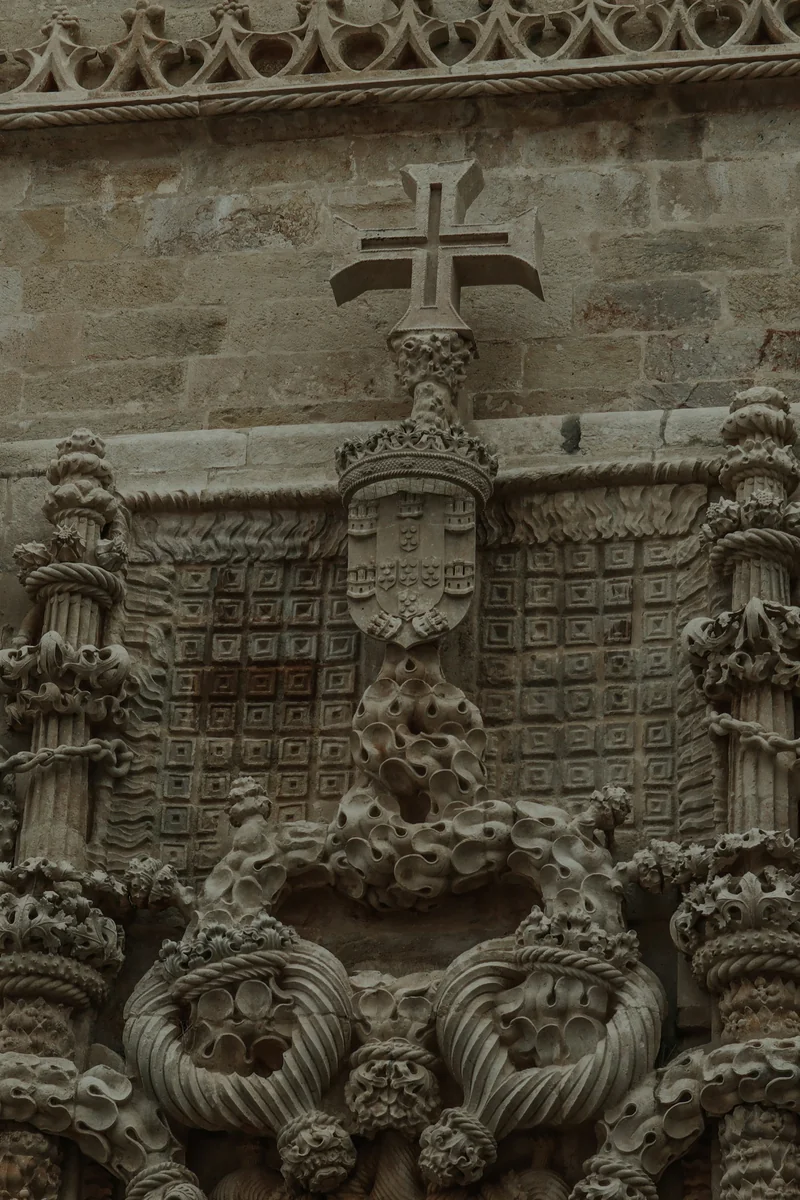
The Janela do Capítulo — the Chapter House window — is a carved limestone window on the west face of the Chapter House, executed in the early 1500s under João de Castilho's workshop. It is the most exuberant single piece of carving in Portuguese architecture and the most-photographed window in Portugal: thick coral, knotted ropes, anchor cables, twisted seaweed, armillary spheres and the Cross of the Order of Christ swarm across the limestone in a virtuoso display of late-Gothic stone-cutting. The window celebrates the maritime wealth that funded the convent's 16th-century expansion.
Each generation of patrons added their own. The Cemetery Cloister and Washing Cloister are 15th-century (under Prince Henry the Navigator). The Cloister of King John III — the Cloister Maior, completed in 1587 under the master architect Diogo de Torralva — is the masterpiece of Portuguese Renaissance architecture. Other cloisters were added under King Sebastian, Cardinal-King Henry and Philip II of Spain. Together they make Convento de Cristo the most cloister-rich monastic complex in Portugal.
The castle and the convent are one continuous fortified complex on the hilltop above Tomar. The 12th-century Templar castle walls and keep enclose the convent buildings; you can walk the outer walls and visit the keep as part of the same ticket. The wooded grounds inside the outer walls — the Mata dos Sete Montes — are open and free to walk.
Ninety minutes to two hours covers the Charola, the nave and Chapter House window, all eight cloisters and the castle keep at a steady pace. Add half an hour if you want to walk the walls, and longer again for the Mata dos Sete Montes woodland and the aqueduct inside the outer ramparts.
The first hour after opening on a Tuesday, Wednesday, Thursday or Friday. The Charola is at its quietest then and the light in the great cloister is low and raking. Coach groups arrive mid-morning and thin out after 15:00; the last ninety minutes before closing are the second-best window, and the Chapter House window glows in late-afternoon sun.
No. The Order of Christ was dissolved with all Portugal's religious orders in 1834, and the Charola and the Manueline nave are now part of the ticketed monument rather than a working parish. They remain consecrated spaces, so a quiet voice inside the rotunda is appreciated.
Yes, for personal use, handheld and without flash. Tripods and any commercial shoot need a permit arranged with the operator in advance. The Charola's painted interior and the Chapter House window from the terrace below are the two frames everyone wants.
The Charola is the original heart of the Convent of Christ and the building most visitors come furthest to see, a round Templar church built in the late twelfth century, its oratory completed around 1160 under Grand Master Gualdim Pais. It is a sixteen-sided polygon enclosing an octagonal central drum ringed by an ambulatory gallery, all under a high vaulted dome, its design modelled after the round structures the Templars knew in Jerusalem: the Church of the Holy Sepulchre and the Mosque of Omar, the Dome of the Rock. Round Templar churches are rare in Europe, which makes this one a landmark of medieval architecture. King Manuel I had the once-austere interior painted and gilded from the early 1500s, and that sixteenth-century paintwork of saints, angels and biblical scenes survives substantially intact today, wrapping the stone in colour that most Romanesque rotundas lost centuries ago.
The Janela do Capitulo of the Convent of Christ, carved by Diogo de Arruda between 1510 and 1513, is the single most-photographed piece of stonework in Portugal and the most virtuoso carved window in Portuguese architecture. Read it as a programme of maritime emblems: the armillary sphere that was King Manuel I's personal device, the Cross of the Order of Christ that flew on every caravel's sail, knotted ropes and anchor cables, twisted seaweed, coral and vegetal motifs, all swarming across a two-storey limestone frame flanked by columns shaped like ships' masts. The whole composition celebrates the Age of Discoveries that the Order of Christ financed. It faces west, so late-afternoon light makes the limestone glow gold, the finest moment to photograph it from the terrace below. Stand back to read the emblems as one seafaring narrative rather than a set of isolated carvings.
Each generation of patrons added its own cloister to the Convent of Christ, spanning the fifteenth to the seventeenth centuries, making it the most cloister-rich monastic complex in Portugal. The Cemetery and Washing cloisters are fifteenth-century, built around 1433 under Prince Henry the Navigator when he was grand master of the Order of Christ. The masterpiece is the Cloister of King John III, the great two-storey Renaissance cloister begun by Diogo de Torralva in 1557 and completed by Filippo Terzi in 1591, a deliberate classical break from the exuberant Manueline of the generation before and one of the finest Renaissance courtyards on the Iberian Peninsula. Walking all eight in sequence is effectively a walking history of Portuguese architecture from about 1400 to 1620, moving from austere Gothic through jewelled Manueline to disciplined classical order, all within a single hilltop enclosure above Tomar.
Plan for an hour and a half to two hours to do the Convent of Christ justice. The round Charola and the long Manueline nave take the first half-hour; walking the eight cloisters in sequence with attention adds another forty-five to sixty minutes; the Chapter House window, the Chapter House itself and the medieval castle walls fill the rest. Travellers who read every interpretive panel budget two and a half hours, and photographers who wait for the late-afternoon light on the Janela do Capitulo should add more time still. If you are also walking the wooded Mata dos Sete Montes inside the outer walls, add thirty to forty-five minutes. The complex spans Romanesque, Gothic, Manueline and Renaissance work across four centuries, so a measured pace rewards you. There is no on-site cafe, so eat in Tomar below, before or after your visit, and arrive at opening for the calmest hour.
There is no formal dress code. Convento de Cristo is a national monument first and a partly consecrated church second — the Charola and the Manueline nave are still used for occasional services but are no longer a parish. Modest dress is appreciated inside the Charola as the most reverent space, but ordinary tourist clothing is perfectly acceptable throughout. Practical footwear matters more than anything: the complex is large, the cloisters and castle walls involve a fair amount of walking on old stone, and the walk up from the town to the gate is steep. Bring a layer, as the covered stone interiors run cool.
Guided tours are sold separately at the on-site ticket office, distinct from our skip-the-line product — ask at the entrance for the day's schedule and languages when you arrive. Because the convent layers nine centuries of building, from the 12th-century Templar Charola to the 16th-century Renaissance cloister, a guide or a good guidebook genuinely helps you read what you are looking at. Interpretive panels are placed throughout, many in the upper-storey rooms that now hold small exhibitions. If you prefer to go at your own pace, this visitor guide and the panels on site are enough to follow the main story unaided.
A military-religious order founded in Jerusalem in 1119 to protect Christian pilgrims to the Holy Land. The Templars became the largest landowner in Christendom by the late 13th century and were dissolved by Pope Clement V in 1312 under pressure from Philip IV of France. In Portugal, King Dinis refused to confiscate Templar lands and instead transferred them to a new royal chivalric order — the Order of Christ — in 1319, preserving the property and personnel intact. Convento de Cristo in Tomar was the Templar headquarters in Portugal and became the headquarters of the Order of Christ.
He was grand master of the Order of Christ from 1420 to 1460 and a major patron of the convent's expansion. Whether he physically lived at Tomar is debated — his recorded residences include Lagos, Sagres and Lisbon — but the order's administrative seat was here and the funds for his exploration projects passed through this complex. The Cross of the Order of Christ painted on every Portuguese caravel's sail came from this convent.
Convento de Cristo is a fortified religious complex on a wooded hilltop above the town of Tomar in central Portugal, roughly 140 kilometres north-east of Lisbon. It was founded in 1160 as a Knights Templar stronghold by the order's Portuguese grand master Gualdim Pais, who began the round Charola — a 16-sided Templar rotunda modelled on the Church of the Holy Sepulchre and the Dome of the Rock in Jerusalem. After the Templars were dissolved in 1312, their Portuguese holdings passed to a new chivalric order, the Order of Christ, chartered in 1319, which later helped finance the Age of Discoveries. King Manuel I expanded the convent in the early 1500s, adding the Manueline nave and the elaborately carved Chapter House window. Eight cloisters span four centuries, making it the most architecturally layered monastic complex in Portugal. UNESCO inscribed it as a World Heritage Site in 1983.
The Convent of Christ began as a Knights Templar stronghold: the Templars founded the castle here from 1118, and its oratory was completed around 1160 under the order's Portuguese grand master Gualdim Pais. When the Templars were dissolved by papal decree in 1312, King Dinis refused to let their Portuguese holdings revert to the crown or the pope. Instead, in 1319 Pope John XXII chartered a new order at his request, the Order of Christ, which inherited the entire Templar estate, and the convent became its seat in 1357. In effect the Portuguese Templars continued under a new name and habit. The Order of Christ went on to become the royal vehicle that financed the Age of Discoveries under Prince Henry the Navigator, which is why both the Templar and the seafaring stories are told side by side throughout the Convent of Christ today.
Prince Henry the Navigator was grand master of the Order of Christ from 1420 to 1460, and the order he led took a share of the spice and gold revenues from the African and Asian voyages and channelled it into building the convent. The Cross of the Order of Christ was painted on the sail of every Portuguese caravel, so the emblem you see carved on the Chapter House window also crossed the world's oceans. The two 15th-century cloisters were added during Henry's time as grand master. For visitors, the convent is where the funding engine of the Discoveries becomes visible in stone.
Yes — the convent sits on a hilltop and the 20-minute walk from the train station includes a 100-metre vertical climb on cobbled streets and a final wooded path. Most independent visitors taxi up from the town and walk down. Drivers should use the convent's own car park near the entrance gate. The walk down through the Mata dos Sete Montes wood is pleasant and shaded in summer.
You can, with a car and an early start: Tomar is about 60 kilometres east of Batalha and 90 from Alcobaça, so the three UNESCO monasteries of central Portugal form a natural loop from Lisbon. Give Tomar the morning window, drive west for Batalha after lunch, and finish at Alcobaça before the drive back. By train it is a two-day plan.
By train, Comboios de Portugal runs direct regional services from Lisbon's Santa Apolónia and Oriente stations to Tomar in roughly two hours, with departures spaced through the day. Tomar station sits at the foot of the hill below the convent, about a 20-minute uphill walk through the town and a wooded path, or a short five-minute taxi ride up to the gate. By car, Tomar lies about 140 kilometres north-east of Lisbon, roughly 90 minutes on the A1 motorway northbound then the A23 eastbound, both of which carry tolls. The route is well signposted from the motorway exit, and there is a car park inside the outer convent walls a short walk from the entrance. Coaches also connect Lisbon's Sete Rios terminal to Tomar in about two hours. Because the convent stands on a steep hilltop, the final climb from the town is the one demanding stretch of any approach.
By train, CP runs direct services from Lisbon's Santa Apolonia and Oriente stations to Tomar in roughly two hours, with departures about every two hours through the day; Tomar station sits at the foot of the hill, a five-minute taxi or a twenty-minute uphill walk through the town to the gate of the Convent of Christ. By car it is about 140 kilometres, around ninety minutes on the A1 and then the A23, with a car park inside the outer walls. Rede Expressos coaches from Lisbon's Sete Rios terminal also reach Tomar in about two hours. Taking the early train or self-driving lets you arrive at opening for the calmest hour, before the coach groups climb the hill. Tomar makes a rewarding day trip from Lisbon, and the historic centre below the convent repays an hour of wandering once you descend.
Yes. Convento de Cristo is open daily year-round, Mondays included, which makes it a useful fixture in a Lisbon itinerary that has run into a Monday — when many city museums close. Hours run seasonally, typically 09:00 to 17:30 from October to May and 09:00 to 18:30 from June to September, with last admission 30 minutes before close. The only days it shuts are the listed Portuguese public holidays: 1 January, 1 March (Tomar's municipal day), Easter Sunday, 1 May, and 24 and 25 December. Always travel on the current published hours for your date.
Yes — the three central-Portugal monasteries are a classic self-drive loop from Lisbon. Convento de Cristo in Tomar lies about 60 kilometres east of Batalha, which is 40 kilometres north of Alcobaça, and all three accept the same skip-the-line booking system. A full day comfortably covers all three with lunch in between, back to Lisbon by early evening. Note that Tomar sits inland from the main coach-tour circuit, so groups that include it tend to arrive in mid-afternoon — meaning independent visitors who reach Tomar early in the day usually have the quietest experience of the three.
The convent has no café, so plan to eat in the old town below, where the streets between Praça da República and the river Nabão hold inexpensive traditional restaurants — try the freshwater fish, regional cured meats, and the egg-yolk pastry doce de fatias. With a full day, the 15th-century Sinagoga de Tomar is one of the best-preserved medieval synagogues in Iberia; the Manueline Church of São João Baptista sits on the main square; and Almourol Castle, a Templar fortress on a river island 30 kilometres south, is one of Portugal's most photogenic ruins. Every four years in early July, Tomar's Festa dos Tabuleiros fills the town.
There isn't one. We are a booking desk, not a tour: the PDF we email carries your QR, and at the convent gate on the hill above Tomar you go straight to the priority lane, show the QR on your phone, and walk in during the half-day window you chose. Keep the confirmation email handy in case a scan needs a surname lookup.
Only if you booked a reduced rate. The 13-to-24 ticket needs a student card or photo ID showing your age, and the 65+ ticket needs photo ID; the gate will not honour the discount without it. Adult tickets need nothing beyond the QR.
Yes. Children of 12 and under enter the convent free, and we never charge for a child. They still need a ticket at the gate: tell us their ages when you book and we register them on the same booking at no cost, so the priority lane admits the whole party together.
The Charola, the Manueline nave, the Chapter House and the larger cloisters are all covered. The castle walls and the outer wooded grounds are exposed. In heavy rain you can still complete the convent visit comfortably; skip the walk along the outer walls.
Once the operator has issued a dated ticket it is fixed to that date and window. Tell us as early as you can and we will ask the operator for a different date on your behalf; changes are not guaranteed, and the earlier we know, the better the chance.
Tickets are issued for a specific date and are non-transferable once issued. All sales are final. If your plans change, reply to your confirmation email at least 48 hours before your date and we will rebook your visit to any open slot in the operator's calendar. The only refund cases are operator-side failures such as an unscheduled closure.
No fixed minute — but the Convent of Christ admits by entry window, so the half of the day does matter. You pick morning (09:00 to 14:00) or afternoon (14:00 to 18:30, closing at 17:00 from November to March) at checkout and arrive at any time inside it; once your window closes, the ticket no longer admits you. We pre-buy your ticket from the official portal, so on arrival you go straight to the priority lane and skip the ticket-office queue rather than waiting at the counter. Staff scan the QR on your phone and you're inside in a few minutes.
Your ticket carries a QR code that arrives by email as a PDF. At the convent gate there are two queues — the standard ticket counter, which can reach 15 to 30 minutes on summer late mornings when coach tours arrive, and a much shorter priority lane for online ticket holders. You go to the priority lane, staff scan the QR inside the PDF, and you pass through within a few minutes. The convent admits by half-day window rather than at a fixed minute, so your ticket is valid at any point inside the morning or afternoon window you chose at checkout — but not after that window closes. Show the QR on your phone or print it — staff scan the code, not the email or receipt.
Yes. The Templar castle setting, the round Charola, the castle walls and the eight cloisters give children plenty of space and atmosphere, and the wooded Mata dos Sete Montes inside the outer walls — with its 17th-century aqueduct and shaded paths — is free to roam and a good run-around after the indoor circuit. There is a lot of walking and some uneven, stepped ground, so a baby carrier works better than a pushchair for the older cloisters and the keep. There is no on-site café, so bring water and snacks; the town below is a 20-minute walk for a proper meal.
Access is partial. Adapted routing covers the Charola, the Manueline nave and the ground floor of several cloisters, but the castle keep, the upper galleries and the older cloisters have step access only, so a full visit is not step-free. The walk up from the town to the gate is steep, so drive, take a taxi, or use the on-site car park a short, flatter walk from the entrance if mobility is a concern. There are toilets near the ticket office. The visit is mostly indoor and covered, so weather rarely affects it apart from the outer wooded grounds and the castle wall walk.
Convent of Christ Tickets is an independent booking desk for international visitors. We are not the operator and we do not sell our own tickets: we buy the official dated ticket for your window, in your name, and we handle what goes wrong from abroad — a Portuguese-first ticketing portal, a steep hill, and a QR that has to scan at the priority lane.
Facts here are checked against the convent's own pages and the sources named below; the date of the last check is on the slab.
Convent of Christ Tickets is an independent booking desk for international visitors to Tomar. We are not the operator and we do not resell tickets: we buy the official dated ticket from Museus e Monumentos de Portugal on your behalf and look after the booking in your own language. Our fee is already inside the price you see. Anyone who prefers to book directly can do so on the operator's own site.